Karnataka High Court Raises Questions About E-Commerce Platform Responsibility
The Karnataka High Court has raised an important question for India's e-commerce industry: what responsibility does an online marketplace have to ensure that products sold through its platform comply with mandatory legal and safety standards?
While hearing Flipkart's challenge to a ₹5 lakh penalty imposed by the Central Consumer Protection Authority (CCPA), the Court asked the company to explain the measures it takes to ensure compliance with applicable BIS requirements for products sold through its platform.
The development is important not only because of the penalty involved, but because it raises a broader issue affecting online marketplaces across India—how far can an e-commerce platform be held responsible for products sold by third-party sellers?
What Is the Background of the Case?
The matter relates to action taken by the CCPA concerning the sale of toys that allegedly did not comply with mandatory standards applicable under the Bureau of Indian Standards (BIS) framework.
The CCPA imposed a ₹5 lakh penalty on Flipkart in connection with the alleged sale of non-compliant toys through its platform.
Flipkart subsequently challenged the CCPA's order before the Karnataka High Court.
Flipkart Challenges the CCPA Order
Before the High Court, Flipkart argued that it operates as an online marketplace where products are offered by third-party sellers.
The company questioned the extent to which an e-commerce marketplace can be held responsible for compliance obligations relating to products sold by independent sellers. It also raised questions regarding the legal and regulatory framework applicable to BIS compliance.
The matter is therefore not simply about whether a particular product complied with BIS requirements. It also raises the larger issue of the role and responsibility of an online platform in monitoring products listed by sellers.
What Did the Karnataka High Court Ask Flipkart?
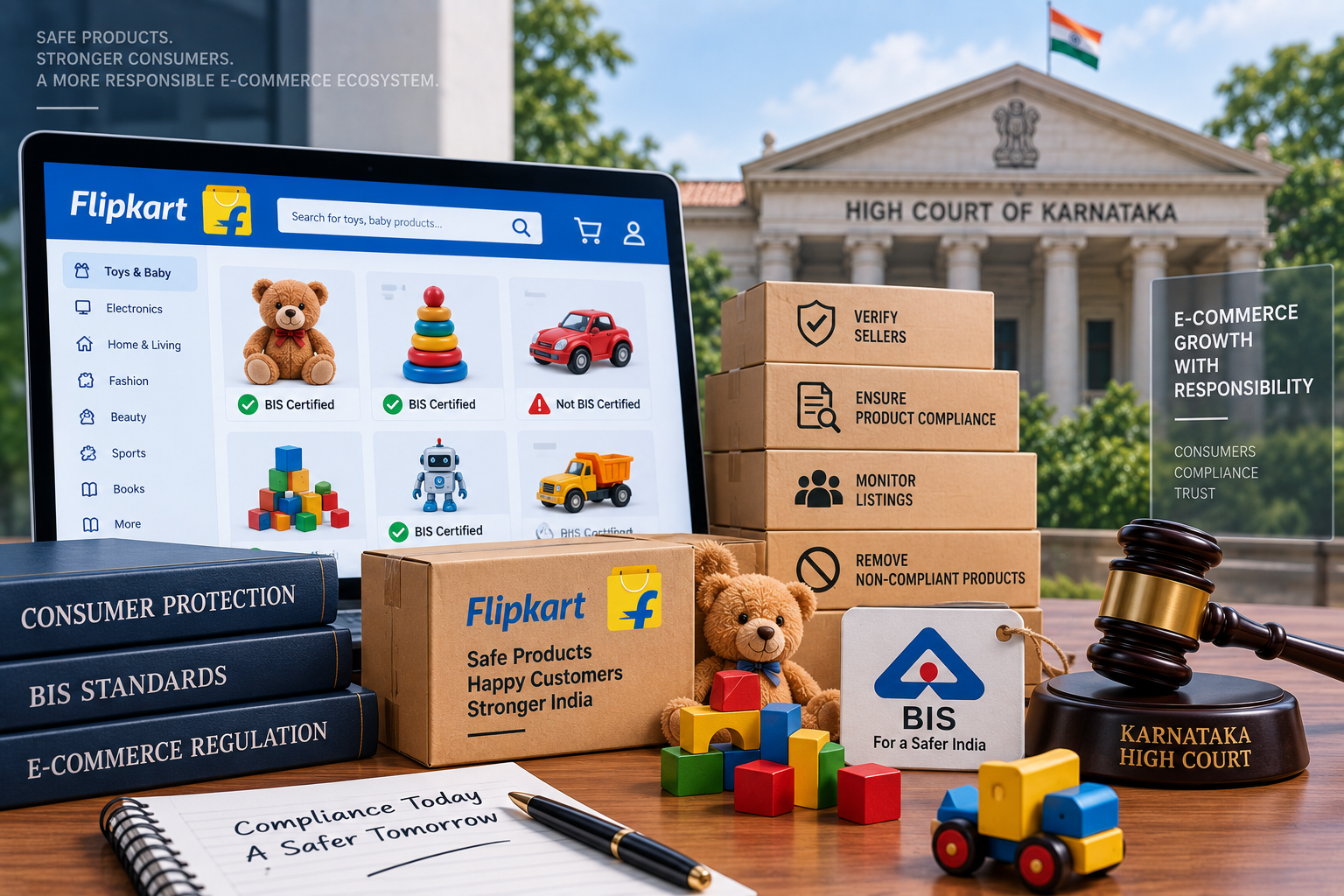
The Karnataka High Court has not yet given a final decision in the case.
At this stage, the Court asked Flipkart to explain its compliance mechanism and the steps taken to ensure that products sold through its platform meet applicable BIS requirements.
The Court's questions bring attention to the practical systems used by online marketplaces, including:
- Seller verification procedures
- Measures to identify non-compliant products
- Systems for removing unlawful listings
- Action taken after receiving regulatory complaints
- Compliance checks relating to mandatory product standards
The case is particularly significant because the products involved were toys, where product safety and consumer protection concerns become especially important.
The Bigger Question: How Responsible Is an Online Marketplace?
Modern e-commerce platforms often operate through third-party sellers. However, consumers generally interact primarily with the platform itself.
They search for products on the platform, rely on the platform's systems and often associate the marketplace's name with the transaction.
This creates an important legal question:
Can an online marketplace simply rely on the fact that a product was sold by a third-party seller, or does its own role in facilitating and promoting the transaction create additional responsibilities?
The answer may depend on several factors, including the nature of the platform's involvement and the representations made to consumers.
Why This Case Matters for E-Commerce Businesses
Although the Karnataka High Court has not yet delivered its final ruling, the case provides an important compliance lesson for online businesses and marketplace operators.
E-commerce platforms should review whether they have adequate systems for:
- Verifying sellers
- Monitoring product listings
- Addressing regulatory complaints
- Removing non-compliant products
- Maintaining proper compliance procedures
- Avoiding misleading representations about product quality or safety
Simply describing a business as an online marketplace may not automatically answer every question relating to legal responsibility. The actual role played by the platform may become relevant.
A Wider Issue for India's E-Commerce Industry
This dispute forms part of a wider discussion about the growing responsibilities of digital platforms.
As e-commerce platforms become more involved in product discovery, payments, logistics, promotions and consumer experience, questions about their legal responsibilities are becoming increasingly important.
The Flipkart matter may therefore be relevant beyond the immediate dispute involving toys and BIS compliance.
The eventual decision could provide useful clarity regarding the responsibilities of online marketplaces when third-party sellers offer products that allegedly violate mandatory legal or safety requirements.
What Happens Next?
The Karnataka High Court has not yet finally decided whether the CCPA's order and ₹5 lakh penalty against Flipkart will be upheld or set aside.
The matter remains pending before the Karnataka High Court, and further proceedings will determine how the Court views the responsibility of an e-commerce marketplace in ensuring compliance with mandatory product standards.
Bottom Line
This case is about more than a ₹5 lakh penalty.
It raises a fundamental question for India's rapidly growing e-commerce industry:
How much responsibility should an online marketplace bear for ensuring that products sold by third-party sellers comply with mandatory Indian laws and safety standards?
The Karnataka High Court's eventual decision could be important for Flipkart as well as other marketplace-based e-commerce businesses operating in India.
For now, the case remains pending.