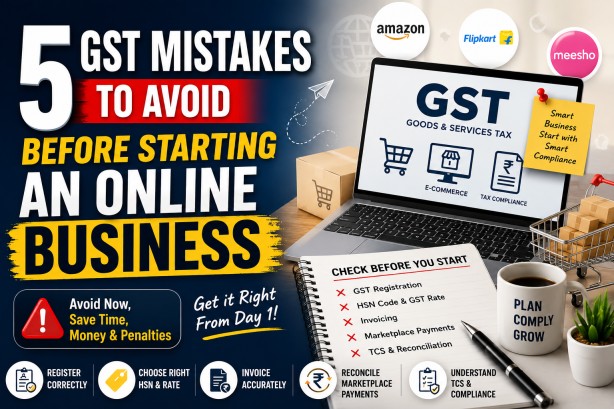
Starting an online business is easier than ever. You can sell products through Amazon, Flipkart, Meesho, your own website, social media or other online platforms.
But there is one thing you should not ignore: GST compliance.
Many new online sellers start by creating a seller account, listing products and looking for customers. They think about GST only after the business starts making sales. That can create problems later.
The good news is that most GST problems can be avoided if you understand the basic rules before starting your business. Here are five common GST mistakes that online sellers should avoid.
1. Assuming Every Online Seller Must Register for GST — or That No Registration Is Needed
This is one of the biggest mistakes. You may have heard:
"If I sell on Amazon or Flipkart, GST registration is always compulsory."
That statement is too broad under the current rules. GST registration for an online seller depends on factors such as:
- What you are selling
- Whether you are selling goods or services
- Which platform you are using
- Whether the platform is an e-commerce operator required to collect TCS
- Your turnover
- Whether you make inter-State supplies
- Whether you fall under a specific exemption or special procedure
The GST framework generally requires compulsory registration for persons supplying through certain e-commerce operators. However, since October 2023, eligible small suppliers of goods can claim an exemption from mandatory registration, subject to specified conditions — including staying within the applicable registration threshold and not making inter-State supplies through the e-commerce operator.
The practical lesson
Do not decide whether you need GST registration only by looking at your expected turnover. Before starting your online business, check:
- What are you selling?
- Where are you selling?
- Which platform are you using?
- Are you selling through a marketplace or your own website?
- Are you eligible for any GST exemption?
- Will you make inter-State supplies?
A small online seller and a large marketplace seller may have very different GST requirements.
2. Registering for GST Without Planning Your Business Properly
Getting a GSTIN is not the same as properly setting up your business. Before applying for GST registration, first decide who will actually run the business — for example, as a sole proprietorship, partnership firm, LLP, private limited company, or another suitable structure.
Your business structure should be properly aligned along this chain:
PAN → Bank Account → GST Registration → Invoices → Marketplace Account → Accounting Records
Why this matters
Suppose you start selling products personally and later decide to move the business to a company. You may then have to deal with changes across your GST registration, marketplace seller account, bank account, invoices, inventory records, accounting records and business ownership — all at once. This creates unnecessary compliance work.
A better approach
Before applying for GST registration, decide who owns the business, where it is operated from, and through which entity the sales will be made. Then keep the GST registration and other business records consistent with that structure.
GST registration is also State/UT-specific, so the State from which you are operating and the nature of your business activities should be considered carefully while registering.
3. Choosing the Wrong HSN Code or GST Rate
This mistake is very common among new online sellers. A seller may search for a product online, see another seller using a particular HSN code, and simply copy it. That is not a good GST practice.
The correct classification depends on the actual nature and characteristics of the goods or services. The GST rate should be determined only after establishing the correct classification and checking the applicable notification and conditions.
Why does this matter?
Charging GST at the wrong rate can result in:
- Short payment of GST
- Interest liability
- Tax demand
- Incorrect GST returns
- Problems during reconciliation
If you sell several products under different categories, do not assume that all of them carry the same GST rate just because they are sold through the same Amazon or Flipkart account.
Before listing a product, check
Product → Correct Classification → HSN → GST Rate → Applicable Conditions
For a registered person, a GST tax invoice must contain the prescribed particulars, including the applicable HSN/SAC details, description and value of the supply, along with other required information. The number of HSN digits required may depend on the applicable rules and the taxpayer's circumstances.
Simple rule
Do not copy the HSN code from another seller. Check the classification of your own product.
4. Treating the Marketplace Payout as Your Actual Sales
This is one of the most important accounting and GST mistakes made by online sellers.
Suppose your online marketplace shows sales of ₹1,00,000. After deducting marketplace commission, shipping charges, other platform charges, returns, refunds and other adjustments, the marketplace may deposit only ₹80,000 into your bank account.
A new seller may look at the bank statement and think, "My sales are ₹80,000." But the amount received in the bank account and the value of your supplies are not necessarily the same thing. The marketplace settlement needs to be properly reconciled with your sales records and GST records.
What should you reconcile?
A proper reconciliation typically flows through:
Marketplace Orders → Sales / Tax Invoices → Returns & Refunds → Marketplace Charges → TCS → GST Returns → Bank Settlement
This becomes increasingly important as your business grows.
5. Ignoring GST TCS and Thinking Marketplace Compliance Ends With GST Returns
If you sell through an e-commerce operator covered by the GST TCS provisions, the operator may collect Tax Collection at Source (TCS) on eligible taxable supplies where the consideration is collected by the operator. This creates an additional reporting and reconciliation trail between the marketplace and the seller.
The amount collected as TCS is reported by the e-commerce operator and reflected in the seller's electronic cash ledger, subject to the applicable rules.
Why should you care?
If your marketplace has deducted TCS but your books or GST records do not match the marketplace data, you may later find differences between the marketplace statement, GST portal data, sales records, GST returns and bank statement — and these differences can make reconciliation difficult.
Your own website is different
If you sell your own products through your own website, the GST TCS provisions do not automatically require you to collect TCS from yourself. Per the official CBIC FAQ on e-commerce, where a person sells their own products through their own website, there is no TCS requirement under Section 52 merely because the website falls within the broad definition of an electronic commerce operator — the normal GST provisions applicable to the supply continue to apply.
So, selling on a marketplace like Amazon or Flipkart and selling through your own website should not simply be treated as the same GST situation.
Bonus: Do Not Ignore Input Tax Credit
Although it is not one of the five main mistakes above, new online sellers should also pay attention to Input Tax Credit (ITC) from the beginning.
If you are registered under GST, eligible GST paid on business purchases and expenses may be available as ITC, subject to the conditions of the GST law. But you cannot simply claim every GST amount appearing on a purchase invoice — proper documentation and other applicable conditions must be satisfied.
Keep your purchase invoices properly maintained and regularly reconcile your records with the GST data available to you.
GST Checklist for a New Online Seller
Before making your first online sale, ask yourself these questions:
| Check | What You Should Verify |
|---|---|
| GST Registration | Do I actually need GST registration, or am I eligible for an exemption? |
| Business Structure | Is my PAN, bank account, GST and marketplace account properly aligned? |
| HSN & GST Rate | Have I correctly classified every product? |
| Invoicing | Are my invoices being prepared with the required GST particulars? |
| Marketplace Reconciliation | Can I reconcile sales, returns, fees, TCS and bank settlements? |
| ITC | Am I maintaining proper purchase invoices and claiming only eligible credit? |
| Returns | Do I know which GST returns/statements apply to my business? |
Final Takeaway
Starting an online business is not just about creating an account on Amazon, Flipkart or another platform and listing your products. Your GST registration, product classification, invoicing, accounting and reconciliation should be planned from the beginning.
At the same time, do not assume that every online seller automatically needs GST registration. The current GST framework contains specific rules and exemptions for certain categories of e-commerce sellers, and the correct answer depends on the nature of your business and the way you sell.
A few hours spent getting your GST setup right can save you from much bigger compliance problems later.
Starting an Online Business?
If you are planning to sell through Amazon, Flipkart, Meesho, your own website or another online platform, and you are unsure about GST registration, HSN classification, invoicing, ITC or e-commerce compliance, it is better to get the structure checked before you start selling.
Need help with your online business GST setup? Talk to Taxation360 Advisory for professional GST and tax assistance.