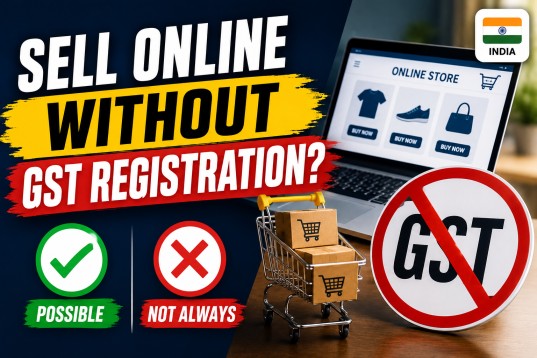
Can You Sell Online Without GST Registration in India?
If you are planning to start an online business, one of the first questions you are likely to have is:
Do I need a GST registration before I can start selling online?
The answer is not the same for every seller.
A person selling products through their own website may have a different GST position from someone selling through Meesho, Amazon, Flipkart or another marketplace. The nature of the product, the place from which supplies are made, whether the supplies are inter-State and the turnover of the business can all affect whether GST registration is required.
There is also an important change that many new sellers are still unaware of. Eligible small suppliers of goods can, subject to specific conditions, supply through certain e-commerce operators without taking regular GST registration.
However, this does not mean that anyone can sell anything online across India without a GST number.
Let's understand where the law actually allows this and where it does not.
The First Question Is Not What You Sell — It Is Where You Sell
Before deciding whether GST registration is required, first look at your business model.
Are you selling directly through your own website?
Or are you listing your products on an e-commerce marketplace such as Meesho, Amazon or Flipkart?
This distinction matters because supplies made through certain e-commerce operators are subject to special GST provisions.
For this reason, two sellers dealing in exactly the same product can have different compliance requirements simply because they are using different sales channels.
Selling Through Your Own Website
If you operate your own website and customers place orders directly with you, simply having an online store does not automatically make GST registration compulsory from your first sale.
Your GST liability will generally depend on the normal registration provisions applicable to your business.
For a supplier of goods, the applicable turnover threshold and other registration provisions need to be considered. In many cases, the threshold for suppliers of goods can be up to ₹40 lakh, subject to the applicable conditions, State-specific rules and other provisions requiring registration.
The position can also change if your business makes supplies that fall under compulsory registration provisions or other special rules.
So, the simple fact that your shop is online rather than offline does not by itself mean that you must obtain GST registration before making your first sale.
Example
Suppose you start a small clothing brand and sell products only through your own website.
The fact that customers place orders online does not automatically make GST registration compulsory. Your turnover and the nature of your supplies will need to be examined under the applicable GST registration provisions.
Selling Through Amazon, Flipkart, Meesho or Other Marketplaces
This is where many sellers get confused.
Under GST law, suppliers making supplies through certain e-commerce operators historically faced compulsory registration requirements irrespective of turnover.
However, from 1 October 2023, eligible unregistered suppliers of goods were given relief from mandatory registration for supplies made through e-commerce operators required to collect TCS under Section 52, subject to prescribed conditions.
This means that a small supplier of goods may be able to sell through an eligible e-commerce operator without obtaining regular GST registration.
But the conditions are important.
This is not a general exemption for every online seller.
Who Can Sell Through an E-Commerce Operator Without GST Registration?
The relaxation is available to eligible suppliers of goods who satisfy the conditions prescribed under GST law.
The most important conditions are discussed below.
1. Your Turnover Must Be Within the Applicable Registration Threshold
The exemption is meant for small suppliers.
Your aggregate turnover in the preceding financial year and the current financial year should not exceed the turnover limit above which registration becomes mandatory in the relevant State or Union Territory.
This means you should monitor your turnover regularly.
It is not advisable to assume that because you started without GST registration, you can continue without reviewing your turnover as the business grows.
2. You Cannot Make Inter-State Supplies of Goods Under This Facility
This is one of the most important restrictions.
An unregistered supplier using this facility cannot make inter-State supplies of goods.
This means you should not assume that the facility allows you to sell to customers anywhere in India without GST registration.
For an online seller, this point is particularly important because marketplaces can receive orders from customers located in different States.
The practical structure of your sales and fulfilment model must therefore be checked before relying on the exemption.
3. You Can Supply Through an E-Commerce Operator in Only One State or Union Territory
The facility is not designed for a multi-State unregistered marketplace business.
An eligible supplier cannot use this exemption to make supplies through an e-commerce operator in more than one State or Union Territory.
This condition is often overlooked by sellers who focus only on the turnover threshold.
4. You Need a PAN and an Enrolment Number
Eligible unregistered suppliers are required to declare their PAN and relevant business details on the GST common portal.
After successful validation, an enrolment number is granted.
No supply should be made through the eligible e-commerce operator before the enrolment number has been obtained.
GSTIN and Enrolment Number Are Not the Same
This is another area where new sellers often get confused.
A GSTIN is issued after obtaining GST registration.
An Enrolment Number is different. It is part of the special mechanism available to eligible unregistered suppliers of goods who want to supply through an e-commerce operator under the prescribed conditions.
So, obtaining an enrolment number does not mean that you have become a regular GST-registered taxpayer.
You should therefore not describe yourself as GST registered merely because you have obtained an enrolment number for this facility.
Can You Sell on Meesho Without a GST Number?
For eligible sellers, the answer can be yes.
Meesho currently provides an onboarding route for sellers who do not have a GSTIN. Such sellers can obtain an Enrolment ID/UIN and register as eligible non-GST sellers.
However, the facility is subject to the conditions applicable under GST law.
In practical terms, non-GST sellers should be especially careful about the State in which they are allowed to sell.
The platform's onboarding facility does not remove the legal conditions attached to the GST exemption.
In Simple Terms
If you are eligible under the GST provisions and obtain the required Enrolment ID/UIN, Meesho may allow you to sell without a regular GSTIN under its current seller onboarding process.
But eligibility should be checked before starting sales.
Can You Sell on Amazon Without a GST Number?
This is where GST law and marketplace policy need to be kept separate.
Amazon's current seller guidance generally requires GST details for sellers listing taxable goods. It separately provides for sellers dealing exclusively in GST-exempt products.
Therefore, even if GST law provides a particular exemption or facility in certain circumstances, you should not automatically assume that Amazon will allow you to list taxable goods without a GSTIN.
The practical rule is simple:
First check whether GST law allows your business to operate without registration. Then check whether the marketplace currently supports that model.
Both questions need to be answered separately.
What About Selling GST-Exempt Products?
If a person is exclusively engaged in supplying goods that are wholly exempt from GST, the registration position can be different.
However, you should be very careful before assuming that your product is exempt.
GST treatment can depend on the exact product, its classification and the applicable exemption notification.
A product should not be treated as exempt merely because someone selling a similar product has described it as GST-free.
If your business is based on the assumption that a product is exempt, it is worth confirming the classification before starting sales.
Your Own Website vs Marketplace: A Quick Comparison
| Business Model | Main Point to Check |
|---|---|
| Selling goods through your own website | Normal GST registration provisions and applicable turnover threshold |
| Selling through an eligible e-commerce operator without GST registration | Eligibility under the special conditions for unregistered suppliers |
| Making inter-State supplies of goods | Whether compulsory registration or other provisions apply; the special ECO facility for unregistered suppliers does not permit inter-State supply of goods |
| Selling goods in more than one State through an ECO without GST registration | The special facility may not be available |
| Providing services online | Registration rules applicable to services must be examined separately |
| Selling exclusively GST-exempt goods | Whether the goods are genuinely and wholly exempt under GST |
| Selling through Amazon | Current marketplace onboarding requirements must also be checked |
| Selling through Meesho without a GSTIN | Current Enrolment ID/UIN facility and applicable GST conditions must be satisfied |
The Biggest Mistake New Online Sellers Make
Many people search online for:
"Can I sell online without GST?"
They find one answer and assume it applies to every business.
That is where problems start.
One seller may be selling only within a single State.
Another seller may be receiving orders from customers across India.
One may be selling physical goods.
Another may be providing services.
One may be selling through Meesho.
Another may be selling through Amazon.
These businesses may look similar from the outside, but their GST position can be different.
For this reason, it is risky to copy another seller's GST structure without understanding your own business model.
Before You Start Selling, Check These Five Things
1. What Exactly Are You Selling?
First determine whether you are supplying:
-
Goods
-
Services
-
GST-exempt products
-
Taxable products
This is the starting point for analysing your GST position.
2. Where Will You Sell?
Will your customers buy through:
-
Your own website?
-
Meesho?
-
Amazon?
-
Flipkart?
-
More than one platform?
The sales channel can affect the registration provisions and practical onboarding requirements.
3. Will You Make Inter-State Supplies?
This is particularly important if you want to use the special facility available to unregistered suppliers selling through e-commerce operators.
The facility for eligible unregistered suppliers of goods comes with restrictions on inter-State supplies.
4. What Is Your Expected Turnover?
Do not look only at your current sales.
If you expect your business to grow quickly, monitor your aggregate turnover from the beginning.
Crossing the applicable registration threshold can change your GST position.
5. Does the Marketplace Support Your Business Model?
GST law and marketplace policy are not always identical.
A particular marketplace may have its own seller onboarding requirements.
Therefore, before investing in inventory or setting up your seller account, check the platform's current requirements.
Should You Take Voluntary GST Registration Anyway?
Not every new online business needs to rush into GST registration.
However, voluntary registration may make commercial sense in some situations.
For example, registration may be useful if you expect rapid growth, want to sell across multiple States, need Input Tax Credit on eligible business purchases or want to use a marketplace that requires a regular GSTIN for your product category.
At the same time, GST registration creates regular compliance responsibilities.
Depending on your business, you may need to deal with:
-
GST returns
-
Tax invoices
-
Tax payment
-
Sales reconciliation
-
Marketplace reports
-
TCS-related reconciliation
-
Input Tax Credit compliance
So the decision should be based on your business plan rather than simply registering because someone told you that every online seller needs a GST number.
A Practical Example
Suppose two people start selling the same type of clothing online.
The first person sells through their own website and starts with a small local customer base.
The second person lists products through an e-commerce marketplace and wants to sell to customers in multiple States.
Although both businesses are selling the same goods, their GST compliance requirements may not be identical.
The sales channel and the nature of supplies can make a significant difference.
This is why the right question is not simply:
"Do online sellers need GST?"
The better question is:
"Does my particular online business model require GST registration?"
Final Takeaway
Yes, it is possible to sell online without regular GST registration in certain situations.
But there is no single rule that applies to every online seller.
An eligible small supplier of goods may be able to supply through an eligible e-commerce operator without obtaining regular GST registration if all prescribed conditions are satisfied.
Similarly, selling through your own website does not automatically make GST registration compulsory from your first sale.
At the same time, restrictions relating to turnover, inter-State supplies, the State in which supplies are made and marketplace onboarding requirements should not be ignored.
Before starting your online business, get clarity on:
-
What you are selling
-
Whether you are supplying goods or services
-
Where you will sell
-
Whether you will make inter-State supplies
-
Your expected turnover
-
Whether you qualify for the special e-commerce facility
-
The current requirements of the marketplace you plan to use
Getting this right before your first sale is much easier than correcting a GST registration problem after your business has already started.
This article is intended for general informational purposes and should not be treated as legal or tax advice. GST registration requirements depend on the facts of the business and the applicable provisions, notifications and current platform policies.