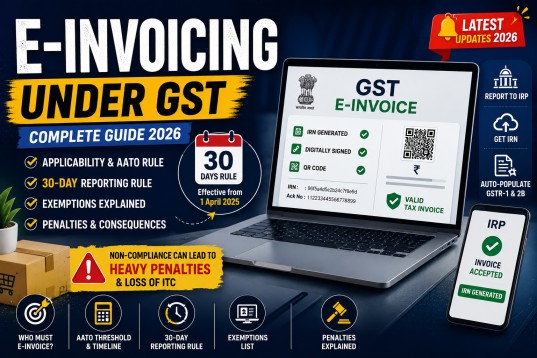
E-invoicing under GST does not mean creating an invoice on a government portal.
A business continues to prepare its invoice using its accounting, billing or ERP software. The prescribed invoice details are then reported to an authorised Invoice Registration Portal (IRP). The IRP validates the details and generates a unique Invoice Reference Number (IRN) along with a QR code.
The e-invoicing system helps improve invoice reporting, reduce fake invoicing and make reconciliation of GST data more efficient.
Who Is Required to Generate E-Invoices?
E-invoicing is currently applicable to registered taxpayers whose aggregate turnover exceeds ₹5 crore in any preceding financial year from 2017-18 onwards, subject to the applicable exemptions.
The turnover is considered at the PAN level. This means that turnover across different GST registrations under the same PAN is considered while determining whether the threshold has been crossed. GSTN's current material also states that once the PAN crosses the threshold, the applicable GST registrations under that PAN are covered, subject to notified exemptions.
Example
Suppose a business has three GST registrations under the same PAN:
| GST Registration | Turnover |
|---|---|
| Maharashtra | ₹2.00 crore |
| Gujarat | ₹2.00 crore |
| Karnataka | ₹1.50 crore |
| Total AATO | ₹5.50 crore |
Since the aggregate turnover is ₹5.50 crore, the ₹5 crore threshold has been crossed.
Therefore, the business should examine e-invoicing applicability for its GST registrations, subject to any applicable exemption.
E-Invoicing Threshold: Phase-wise Timeline
| Phase | AATO Threshold | Effective Date |
|---|---|---|
| Phase 1 | ₹500 crore and above | 1 October 2020 |
| Phase 2 | ₹100 crore and above | 1 January 2021 |
| Phase 3 | ₹50 crore and above | 1 April 2021 |
| Phase 4 | ₹20 crore and above | 1 April 2022 |
| Phase 5 | ₹10 crore and above | 1 October 2022 |
| Phase 6 | More than ₹5 crore | 1 August 2023 |
The current e-invoicing threshold is more than ₹5 crore in aggregate turnover in any preceding financial year from 2017-18 onwards, subject to exemptions.
The 30-Day E-Invoice Reporting Rule
From 1 April 2025, taxpayers having AATO of ₹10 crore or more are required to report invoices, credit notes and debit notes to the IRP within 30 days from the date of the document.
Example
If a covered taxpayer issues an invoice dated 1 April 2026, the invoice must be reported within 30 days.
If the reporting deadline expires, the IRP system will restrict IRN generation for that document.
Therefore, businesses covered by the 30-day rule should have an internal process to ensure that invoices, credit notes and debit notes are reported on time.
Which Documents Are Covered by E-Invoicing?
For taxpayers covered by the e-invoicing mandate, e-invoicing generally applies to:
-
Tax invoices for B2B supplies
-
Export invoices
-
Supplies to SEZs
-
Deemed export invoices
-
Credit notes
-
Debit notes
B2C invoices are generally outside the e-invoicing reporting mandate.
The exact applicability can depend on the nature of the transaction and the applicable GST provisions.
Who Is Exempt from E-Invoicing?
Certain categories of registered persons are exempt from mandatory e-invoicing even if they cross the applicable turnover threshold.
These include:
| Exempt Category |
|---|
| Insurance companies |
| Banks and financial institutions, including NBFCs |
| Goods Transport Agencies (GTAs) |
| Suppliers of passenger transportation services |
| Suppliers of services by way of admission to exhibition of cinematograph films in multiplex screens |
| SEZ units |
| Government departments and local authorities |
| Specified OIDAR suppliers registered under Rule 14 of the CGST Rules |
These exemptions are prescribed through the applicable GST notifications. The exemption is generally linked to the entity/category, rather than being determined separately for each individual supply. CBIC has also clarified that the notified exemption applies to the entity as a whole.
Important: SEZ Unit vs SEZ Developer
Do not confuse an SEZ unit with an SEZ developer.
The notified e-invoicing exemption applies to SEZ units. An SEZ developer should not assume that it is exempt merely because it is associated with an SEZ.
How Does E-Invoicing Work?
Step 1 — Prepare the Invoice
Prepare the invoice using your accounting, billing or ERP software with the required GST particulars.
Step 2 — Report the Invoice to an IRP
The prescribed invoice details are reported to an authorised Invoice Registration Portal through the applicable portal, API or other permitted mechanism.
Step 3 — IRP Validates the Details
The IRP validates the submitted invoice data and checks the required fields.
Step 4 — IRN Is Generated
After successful validation, the system generates a unique Invoice Reference Number (IRN) and provides the authenticated invoice details along with a QR code.
Step 5 — Issue the E-Invoice
The supplier can use the authenticated invoice for the transaction. The IRN and QR code form an important part of the e-invoice.
Step 6 — Data Flows to GST Returns
The reported invoice data is used for auto-population of the supplier's GST return data, including GSTR-1. Relevant invoice information is also made available to the recipient through the GST system, including GSTR-2B as applicable.
What Happens If E-Invoicing Is Not Followed?
If a taxpayer who is required to generate an e-invoice issues an invoice without following the prescribed e-invoicing procedure, the invoice may not be treated as a valid invoice under Rule 48(5) of the CGST Rules.
The GST law also contains penalty provisions for invoice-related non-compliance. The exact consequence depends on the nature of the violation and the applicable provisions.
For the recipient, a non-compliant invoice can also create problems with Input Tax Credit (ITC) because ITC is subject to the conditions prescribed under Section 16 of the CGST Act.
Therefore, businesses covered by e-invoicing should not treat IRN generation as an optional post-invoice activity.
Common E-Invoicing Mistakes to Avoid
1. Missing the 30-Day Reporting Deadline
Taxpayers with AATO of ₹10 crore or more must report invoices, credit notes and debit notes within 30 days from the document date.
The IRP system restricts IRN generation when the applicable reporting window has expired.
2. Checking Turnover GSTIN-Wise Instead of PAN-Wise
E-invoicing applicability is based on aggregate turnover at the PAN level.
Therefore, businesses should consider turnover across their GST registrations under the same PAN.
3. Assuming an Exempt Entity Must Generate E-Invoices
Certain categories of taxpayers are specifically exempt from e-invoicing.
A business should check whether it falls within a notified exemption before treating e-invoicing as mandatory.
4. Assuming B2C Invoices Always Require an IRN
B2C invoices are generally outside the e-invoicing reporting mandate.
However, other GST requirements may still apply to the transaction.
5. Cancelling an IRN After 24 Hours
An IRN can generally be cancelled on the IRP only within 24 hours of its generation.
After this period, the IRN cannot be cancelled through the IRP. The appropriate GST document or correction mechanism will depend on the nature of the error or transaction.
E-Invoicing Compliance Checklist
Before closing your GST compliance process, check the following:
| Check | What to Verify |
|---|---|
| AATO | Has your aggregate turnover crossed the applicable ₹5 crore threshold? |
| PAN-level turnover | Have you considered turnover across all GSTINs under the same PAN? |
| Exemption | Does your business fall under any notified e-invoice exemption? |
| 30-day rule | If AATO is ₹10 crore or more, are invoices, credit notes and debit notes being reported within 30 days? |
| IRN | Is a valid IRN being generated for every applicable document? |
| QR Code | Is the required QR code appearing on the e-invoice? |
| Reconciliation | Are e-invoice data and GST returns being reconciled regularly? |
| Cancellation | Are incorrect IRNs being cancelled within the permitted time where cancellation is required? |
Key Legal References
| Reference | Purpose |
|---|---|
| Notification No. 13/2020 – Central Tax | E-invoicing framework and specified exemptions |
| Notification No. 10/2023 – Central Tax | Reduced e-invoicing threshold to more than ₹5 crore from 1 August 2023 |
| Rule 48(4) of the CGST Rules | E-invoicing requirement for notified taxpayers |
| Rule 48(5) of the CGST Rules | Consequence of issuing an invoice otherwise than in the prescribed manner |
| GSTN/IRP Advisory – March 2025 | 30-day reporting requirement for taxpayers with AATO of ₹10 crore or more from 1 April 2025 |
Final Takeaway
E-invoicing is now an important part of GST compliance for businesses crossing the prescribed turnover threshold.
For most taxpayers, the key numbers to remember are:
| Key Number | What It Means |
|---|---|
| ₹5 crore | Current e-invoicing applicability threshold |
| ₹10 crore | AATO threshold for the 30-day reporting rule |
| 30 days | Reporting window for covered taxpayers with AATO of ₹10 crore or more |
| 24 hours | General IRN cancellation window |
Businesses should regularly review their turnover, exemption status and reporting process to ensure that applicable e-invoices are generated and reported correctly and on time.
This guide is for general informational purposes and does not constitute legal or tax advice. GST rules, notifications and portal procedures may change. For specific compliance requirements, consult a qualified tax professional.