E-invoicing does not mean creating invoices on the government portal. It means reporting invoices you have already prepared — in the prescribed JSON format — to the Invoice Registration Portal (IRP), operated by GSTN. The IRP validates the invoice, assigns a unique Invoice Reference Number (IRN), digitally signs it, and returns it with a QR code.
This authenticated invoice is then treated as a valid tax invoice under GST law. The system was introduced to reduce fake invoices, eliminate ITC fraud, and automate reconciliation between supplier and recipient records in GSTR-1 and GSTR-2B.
Who Must Issue E-Invoices? — Applicability in 2026
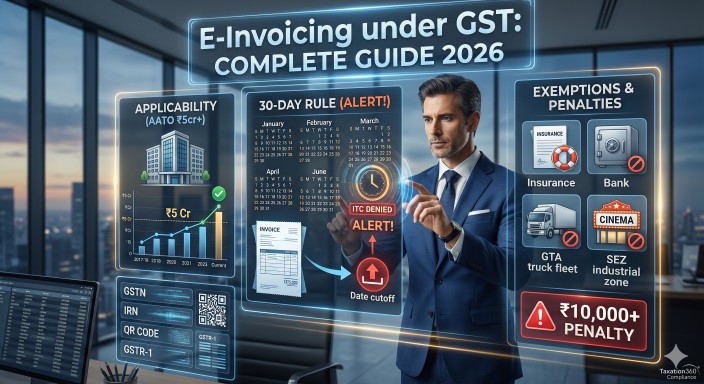
As per CBIC Notification No. 10/2023 — Central Tax dated 10 May 2023, e-invoicing is mandatory for all registered taxpayers whose Aggregate Annual Turnover (AATO) exceeds ₹5 crore in any financial year from 2017-18 onwards, with effect from 1 August 2023.
Key point on AATO calculation: Turnover is aggregated across all GSTINs under a single PAN — not just one branch or registration. If your combined turnover across all your GSTINs exceeds ₹5 crore in any year since 2017-18, e-invoicing applies to you today.
Applicability Threshold — Phase-wise Timeline
| Phase | AATO Threshold | Effective Date |
|---|---|---|
| Phase 1 | ₹500 crore+ | 1 Oct 2020 |
| Phase 2 | ₹100 crore+ | 1 Jan 2021 |
| Phase 3 | ₹50 crore+ | 1 Apr 2021 |
| Phase 4 | ₹20 crore+ | 1 Apr 2022 |
| Phase 5 | ₹10 crore+ | 1 Oct 2022 |
| Phase 6 (Current) | ₹5 crore+ | 1 Aug 2023 |
The 30-Day Reporting Rule — Applicable from 1 April 2025
For taxpayers with AATO of ₹10 crore and above, CBIC has mandated that invoices, credit notes, and debit notes must be reported to the IRP within 30 days from the date of the document.
Once this 30-day window closes, the IRP system auto-blocks the upload. The document will be rejected — no IRN will be generated, making the invoice invalid under GST law. The recipient cannot claim Input Tax Credit on such an invoice.
Practical implication: If you issued a B2B invoice on 1 April 2026, the last date to upload it to the IRP is 30 April 2026. Miss this — and the invoice is void for ITC purposes.
Which Documents Require E-Invoicing?
E-invoicing is mandatory for the following documents in B2B and B2G transactions:
- Tax invoices (supply of goods and services)
- Credit notes and debit notes
- Export invoices
- Supplies to SEZ units (with or without IGST)
- Deemed exports
Not required for: B2C invoices, nil-rated and exempt supplies, non-taxable supplies.
Who is Exempt from E-Invoicing?
Despite crossing the ₹5 crore threshold, the following categories are exempt as per Notification No. 13/2020 — Central Tax (as amended):
- Insurance companies — life, general, and health
- Banks and NBFCs — including banking companies and financial institutions
- Goods Transport Agencies (GTAs) — transporting goods by road
- Passenger transport service providers
- Multiplex cinema operators — for admission tickets
- SEZ Units — note: SEZ developers are not exempt; only SEZ units
Important: Exempt businesses should use the "E-invoice Exemption Declaration" facility on the GST portal. Without this, you may receive automated compliance notices even if you are genuinely exempt.
How E-Invoicing Works — Step by Step
Step 1 — Prepare the invoice in your accounting or billing software in the prescribed JSON format as per GSTN specification.
Step 2 — Upload to IRP via one of six authorized Invoice Registration Portals. The main portal is einvoice1.gst.gov.in. API integration through your accounting software is also available.
Step 3 — IRP validates the invoice — checks GSTIN, HSN codes, invoice value, and other mandatory fields.
Step 4 — IRN is generated — a unique 64-character Invoice Reference Number. The IRP digitally signs the invoice and returns it with a QR code.
Step 5 — Use the authenticated invoice for the transaction. The IRN and QR code must be printed on the invoice shared with the buyer.
Step 6 — Auto-population — invoice data is automatically pushed to your GSTR-1 and the recipient's GSTR-2B. No manual entry needed.
Penalties for Non-Compliance
| Violation | Penalty |
|---|---|
| Not generating e-invoice when required | ₹10,000 per invoice or 100% of tax due — whichever is higher |
| Incorrect invoice details | ₹25,000 per invoice |
| Buyer loses ITC | Full ITC denied on invoice without valid IRN |
| Audit and scrutiny risk | Returns mismatch triggers notices |
Common Mistakes to Avoid
1. Generating IRN after the 30-day window (₹10 crore+ taxpayers)
Once 30 days pass from the invoice date, the IRP will reject the upload. There is no option to generate IRN after this point.
2. Not aggregating turnover across all GSTINs
Many businesses check only their main GSTIN. The ₹5 crore threshold applies to the combined turnover of all GSTINs under your PAN.
3. Cancelling e-invoices after 24 hours on the IRP
Cancellation on the IRP is only allowed within 24 hours of IRN generation. After that, you must issue a credit note.
4. Assuming B2C invoices need IRN
E-invoicing is mandatory only for B2B, B2G, and export documents.
5. Not filing E-Invoice Exemption Declaration
Exempt businesses that skip this declaration on the portal may receive automated notices.
Key CBIC Notifications
| Notification | Subject |
|---|---|
| No. 13/2020 — Central Tax, 21 Mar 2020 | Original e-invoicing notification |
| No. 10/2023 — Central Tax, 10 May 2023 | Reduced threshold to ₹5 crore w.e.f. 1 Aug 2023 |
| GSTN Advisory, 5 Nov 2024 | 30-day reporting extended to ₹10 crore+ AATO w.e.f. 1 Apr 2025 |
This article is for informational purposes only and does not constitute legal or tax advice. Always verify with the latest CBIC notifications before acting. For specific compliance guidance, consult a qualified tax professional.