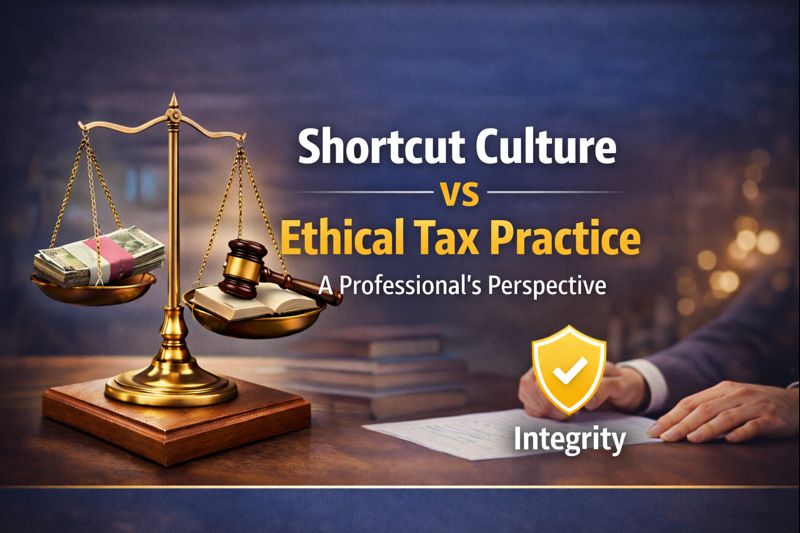
1. Ethics in Tax Practice: A Daily Reality
Tax practice today is not limited to interpreting statutes or filing returns. It involves navigating client expectations, commercial pressure and system-driven compliance requirements. For many tax professionals, the real challenge is not a lack of legal knowledge, but the constant tension between what is legally correct and what the client wants to hear.
This dilemma does not arise in theory. It surfaces in routine conversations, reconciliation meetings and deadline-driven filings, where correct advice is often inconvenient and shortcuts appear attractive.
2. Why Clients Gravitate Towards Shortcuts
Client decisions are rarely driven by intention alone. Financial stress, blocked working capital, delayed payments and intense market competition heavily influence behaviour.
In trading and manufacturing businesses, mismatches between GSTR-1, GSTR-3B, books of accounts and bank statements are common. When discrepancies pile up, anxiety replaces analysis.
At this stage, compliance feels burdensome. Relief becomes the priority.
3. The Appeal of Quick Fixes
Shortcut solutions promise immediate comfort. Unethical intermediaries and contractors often offer reassurance—entries can be adjusted, figures can be matched, and consequences can be avoided because “the system is slow”.
For a stressed client, such assurances sound convincing. Compliance requires effort, documentation and patience. Shortcuts, by contrast, feel effortless.
4. Correct Advice Is Inherently Uncomfortable
Genuine professional advice demands work—collecting records, reconciling supplier data, identifying timing differences and explaining future implications. From the client’s perspective, this appears costly and time-consuming, with no immediate visible benefit.
Incorrect advice, however, postpones consequences. The risk remains hidden, but not eliminated.
5. Ethics as Professional Risk Management
Ethics in tax practice is not a moral luxury. It is a survival mechanism.
Compromising professional standards to retain a client may offer short-term revenue, but it creates long-term exposure. When scrutiny arises, tax, interest and penalties follow—while the source of shortcut advice quietly disappears.
At that point, the professional faces the inevitable question: why was the risk not explained earlier?
6. Genuine Errors vs Improper Adjustments
Not every mismatch is fraudulent. Timing differences, delayed credit notes, goods in transit and accounting cut-offs are part of normal business operations.
The problem begins when such issues are resolved without examination, through blanket adjustments made only to make numbers align.
This is where contractor culture thrives—entries are passed, files are closed, and responsibility is transferred to the future.
7. The Myth of an Ineffective System
A common belief is that the GST system is slow and therefore unreliable. In reality, GST is data-driven.
Cross-verification operates silently. Patterns are tracked, relationships are mapped and inconsistencies surface gradually. An ignored discrepancy today can become a decisive factor tomorrow.
Repeated adjustments often attract more attention than isolated errors.
8. Integrity vs Client Retention
Client retention matters, but professional credibility matters more.
Losing a client may cause temporary financial discomfort. Losing integrity can permanently damage a career. Especially for early-stage professionals, it is crucial to understand that a client’s refusal is temporary, while regulatory consequences are enduring.
9. The Professional’s Duty When Advice Is Rejected
When a client declines correct advice, the professional’s responsibility does not end. It changes form.
Education must continue. Consequences must be explained calmly. Advice must be documented. Participation in unlawful practices must be firmly refused.
A client’s commercial choice can be respected. An illegal act cannot.
10. Documentation Is Professional Insurance
Verbal advice fades. Written advice endures.
Emails, summaries and file notes are not defensive tools—they are essential professional hygiene. During scrutiny, documented advice becomes the strongest shield a professional can have.
11. Long-Term Reality
Shortcut-driven advisors survive until detection. Ethical professionals survive audits, scrutiny and time.
The GST framework may not be perfect, but it is not blind. It may move slowly, but it identifies patterns with certainty.
12. Conclusion: Ethics Is Strength, Not Weakness
Professionalism does not lie in pleasing clients at all costs. It lies in keeping them legally safe.
Tax professionals are not here to exploit systems. They are here to guide businesses through complexity with clarity and integrity.
Ethics requires patience.
Integrity demands courage.
The client may not recognise this today.
The system certainly will tomorrow.