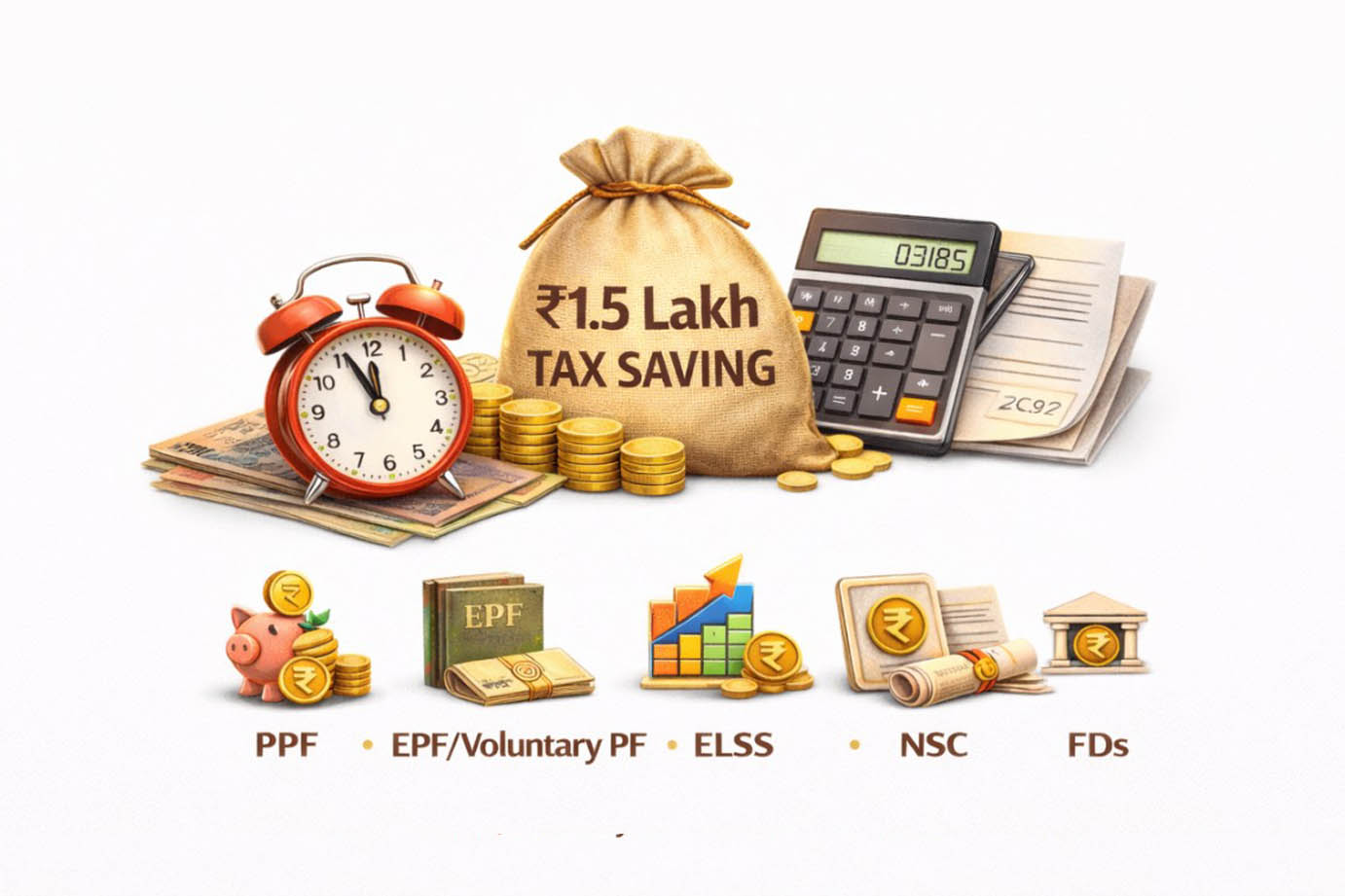
All About Section 80C: Best Ways to Save Tax Up to Rs. 1.5 Lakh – Complete Guide (2025 Update)
Introduction
Section 80C of the Income Tax Act, 1961 is one of the most widely used tax-saving provisions for individuals and Hindu Undivided Families (HUFs) in India. It allows a deduction of up to ?1.5 lakh per financial year from gross total income, thereby reducing taxable income and overall tax liability under the old tax regime.
This guide explains eligibility, eligible investments and expenses, planning strategies, common mistakes, and practical tips to maximize benefits for FY 2025-26 (Assessment Year 2026-27).
1. Key Features of Section 80C
-
Maximum Deduction Limit: Rs. 1.5 lakh per financial year (combined limit under Sections 80C, 80CCC and 80CCD(1)).
-
Eligible Taxpayers: Individuals and Hindu Undivided Families (HUFs).
-
Not Eligible: Companies, partnership firms, LLPs or other non-individual entities.
-
Applicable Regime: Only available under the old tax regime. Not allowed under the new/default tax regime.
-
Investment Period: Investments or eligible expenses must be incurred during the relevant financial year.
2. Who Can Claim Deduction Under Section 80C
-
Resident Individuals
-
Hindu Undivided Families (HUFs)
For individuals, deductions can be claimed for investments or expenses incurred for:
-
Self
-
Spouse
-
Dependent children (subject to conditions)
3. Eligible Investments and Expenses Under Section 80C
The following investments and expenses qualify for deduction under Section 80C, subject to prescribed conditions:
A. Investment-Based Options
-
Public Provident Fund (PPF):
Long-term, government-backed savings scheme with tax-free maturity. Lock-in period of 15 years. -
Employees’ Provident Fund (EPF) / Voluntary PF:
Employee’s contribution qualifies for deduction. -
Equity Linked Savings Scheme (ELSS):
Tax-saving mutual funds with equity exposure and a lock-in period of 3 years. Returns are market-linked. -
National Savings Certificate (NSC):
Fixed-income government scheme with 5-year lock-in. Annual accrued interest (except the final year) is deemed reinvested and eligible for deduction under Section 80C. Final year interest is taxable. -
Tax-Saving Fixed Deposits:
Bank or post-office fixed deposits with a mandatory 5-year lock-in period. Interest is taxable. -
Life Insurance Premiums / ULIPs:
Premiums paid for self, spouse or children qualify, subject to prescribed limits (generally premium not exceeding 10% of sum assured for policies issued after 1 April 2012). -
Sukanya Samriddhi Yojana (SSY):
Contribution for the girl child qualifies under Section 80C.
B. Expense-Based Deductions
-
Home Loan Principal Repayment:
Principal portion of home loan EMI qualifies for deduction. Stamp duty and registration charges for purchase or construction of a residential house are also eligible. Deduction is subject to a lock-in period of 5 years. -
Children’s Tuition Fees:
Tuition fees paid for full-time education in India for up to two children per parent. Only the tuition component is eligible.
4. How to Plan Section 80C Investments Effectively
Conservative Investors
-
PPF + Tax-Saving Fixed Deposit / NSC
-
Suitable for long-term safety and stable returns
Balanced Approach
-
Combination of PPF, ELSS, home loan principal repayment and tuition fees
-
Mix of safety and growth
Growth-Oriented Investors
-
Higher allocation to ELSS with a smaller portion in PPF
-
Suitable for young taxpayers with higher risk tolerance
Tip: Spread investments throughout the year instead of making last-minute investments in March.
5. Common Mistakes to Avoid
-
Assuming ?1.5 lakh deduction is available per investment (it is a combined limit).
-
Ignoring lock-in periods and premature withdrawals.
-
Forgetting to include eligible expenses such as tuition fees or home loan principal.
-
Claiming Section 80C deduction under the new tax regime.
-
Not tracking reinvested NSC interest correctly.
6. How to Claim Section 80C Deduction in ITR
-
Collect and retain investment and payment proofs.
-
Choose the old tax regime while filing the return.
-
Declare the total eligible amount under Section 80C (maximum ?1.5 lakh).
-
Ensure compliance with lock-in and eligibility conditions.
-
Preserve documents for future scrutiny or verification.
7. When Section 80C Works Best
-
Taxpayers in higher tax slabs under the old regime.
-
Salaried individuals with long-term savings goals.
-
Home loan borrowers.
-
Parents planning for children’s education.
-
Young professionals aiming for wealth creation with tax efficiency.
8. When Section 80C May Not Be Ideal
-
If the new tax regime results in lower overall tax.
-
When liquidity is required in the short term.
-
If risk tolerance is very low and equity exposure is unsuitable.
-
If deduction limits are already exhausted through mandatory contributions.
Conclusion
Section 80C continues to be a powerful tax-saving tool for individuals and HUFs under the old tax regime. With proper planning, disciplined investing and correct selection of instruments, taxpayers can save up to ?46,800 in tax (for the 30% slab) while building long-term financial security.
Early planning, diversification and awareness of conditions are key to maximizing benefits under Section 80C.
Disclaimer:
This guide is for general informational purposes based on the Income Tax Act, 1961 as applicable in December 2025. Tax laws are subject to change. Please consult a qualified tax professional for advice specific to your situation.